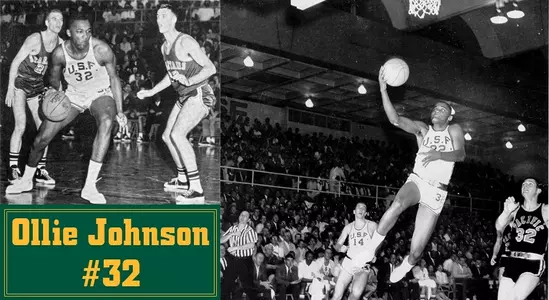
Ollie Johnson becomes the sixth USF men's basketball player to have his jersey retired.
Johnson Takes His Place Alongside USF's All-Time Greats
1/24/2014 7:52:00 AM | Men's Basketball
The 1960s were a decade of change in America.
As baby-boomers became teenagers and young adults, the country began to look at itself differently. Change affected virtually every aspect of society, from politics, social justice, law, entertainment, lifestyles and values.
The timeline of events that unfolded in the mid-'60s are woven into the fabric of American history.
Groups of civil rights, labor and religious organizations took part in the Great March on Washington, where Martin Luther King, Jr. delivered his "I Have a Dream" speech in front of the Lincoln Memorial. Three months later, the nation was paralyzed over the loss of its President.
The Civil Rights Bill of 1964 and the Voting Rights Act of 1965, two of the most important pieces of civil rights legislation in American history, were passed. As military activities were being escalated in a foreign land in Southeast Asia, tensions ran high at home in Mississippi, as well as on the streets of Harlem, Detroit and Watts.
Betty Friedan's "Feminine Mystique" sparked the women's liberation movement, Medicaid and Medicare were enacted and Senator Barry Goldwater introduced grass roots conservatism to the voting public in his ill-fated attempt to unseat President Johnson in 1964.
Cassius Clay became Muhammad Ali and The Beatles landed on America soil for the first time, marking the start of the British Invasion. Across the Bay Bridge, Mario Savio led the Berkeley Free Speech Movement and became an icon for the counterculture movement.
The University of San Francisco experienced its fair share of change during the mid-60s, as well. Under new University President Charles W. Dullea, S.J., USF became coeducational in all academic divisions in 1964. The main campus was transformed with the completion of the Harney Science Center along with the Gillson and Hayes-Healy residence halls. The University Center and Cowell Hall buildings were also added during the decade.
Some things, such as the University's dress code policy, took a little longer to change. Young men wore collared shirts, long pants and dress shoes to class while the newly admitted female population was required to wear blouses, skirts, dress sweaters or coats. Backpacks were virtually non-existent on campus.
USF's students were engaged in social justice activism, especially in the Western Addition neighborhood immediately east of campus where they took part in protest marches following the bombing of the 16th Street Baptist Church in Birmingham. The Free Speech Movement on campus didn't fall on deaf ears, but it certainly didn't have the same affect as the demonstrations that were taking place across the bay.
The early 1960s were also a time of transition for USF's storied men's basketball program, which was less than a decade remove from winning back-to-back NCAA Championships and producing one of the greatest players of all-time in Bill Russell.
From 1954-58, USF compiled a 104-10 overall record, won 60 consecutive games en route to back-to-back national championships in 1955 and '56 and advanced to a third straight Final Four in '57. Only a long buzzer beater by Seattle's Elgin Baylor in the West Regional Finals held at the Cow Palace stood in the way of a fourth consecutive trip to the Final Four in '58.
However, the Dons managed just a 42-62 record over the next four seasons, including a 6-20 campaign in 1958-59, Phil Woolpert's last campaign as head coach. Ross Guidice, a standout on USF's 1949 NIT championship team, was hired as head coach, but resigned after a 9-16 season in 1959-60 to devote more time to his furniture business.
Pete Peletta took the reins and led USF to a 17-11 record in 1960-61, but the Dons slipped to 10-15 the following year. Peletta knew better times were ahead, as Ollie Johnson, a 6-7 power forward from Spingarn High School in Washington, D.C., was quietly biding his time on USF's freshmen team.
While the national championship teams of the mid-50's were made up of players from the Bay Area and surrounding cities, Johnson was one of USF's first national recruits to make a significant impact on the program. However, if it wasn't for Lloyd Moffatt, who played one season with Johnson at USF, his brilliant career might have unfolded at another Bay Area school.
"I knew Ollie from Washington, D.C. and went to Olympic Community College in Bremerton, Wash. with his brother, Andrew," said Moffatt. "Before I went back home for the summer, Coach Peletta asked me if I could talk to Ollie about possibly coming to USF.
"Ollie was all set to go to San Jose State along with some of his other friends from D.C. I talked to Ollie about changing his mind and sold him on the city, the University and the basketball program. I also told him I needed a homey out there so we could fight this battle together. We're all thankful he changed his mind."
Johnson didn't need too much convincing.
"If it wasn't for Lloyd, I don't think I would have gone to USF," said Johnson. "I trusted Lloyd like a brother he really painted a picture of a very close-knit community in one of the most beautiful cities in the world. The academics, structure and location made USF a very special place. The basketball was a bonus.
"As it turned out, USF was everything Lloyd said it would be and more. I'm forever indebted to him."
USF's basketball fortunes immediately turned around once Johnson joined the team during his sophomore year (freshmen were not yet eligible). The Dons went 18-9 in 1962-63, captured its first conference championship in five seasons and returned to the NCAA Tournament. Johnson led the team in both scoring and rebounding.
The following year, the Dons finished with a 27-11 overall mark and went undefeated in conference play en route to their second straight WCAC title. In the 1964 NCAA West Regional Finals, USF led top-ranked UCLA by 12 points at halftime before falling 76-72, as the Bruins went on to win their first of nine national championships under John Wooden. Johnson poured in a team-high 22 points and was named to the all-tournament team.
USF rolled to a 24-5 record and its third straight WCAC title in Johnson's senior season, but was derailed by UCLA for the second consecutive year by UCLA in the West Regional Finals, despite Johnson's 37 points.
"If UCLA was the No. 1 team in the country, then USF was 1-A," wrote Bob Brachman of the San Francisco Examiner.
During Johnson's three-year varsity career from 1962-65, USF compiled a 65-19 record (.774), won three straight WCAC championships and made three NCAA Tournament appearances. Johnson was twice named conference player of the year and earned All-America honors as a senior in 1965.
"Ollie brought USF basketball back to the national spotlight," said former USF head coach Jim Brovelli, who was a teammate of Johnson's for two seasons. "The success of the championship teams of the mid-50's is well-documented, but it wasn't until Ollie arrived on campus that USF became a national power again.
"The teams of the mid-60's had some really good players, guys like Joe Ellis and Erwin Mueller who went onto play in the NBA. But Ollie was a shot blocker, a scorer and rebounder. He did it all and was the glue that took the program to the next level. He made all of us better players."
Another former teammate, Dan Belluomini, who coached the Bill Cartwright-led teams to national prominence in the late 70's, remembers Johnson as being a "big game player."
"Ollie played his best in big games. Take a look at those two UCLA games in the NCAA Tournament and he was arguably the best player on the floor. He was a game-changer. USF went from mediocre to winning championships and he was the reason."
Statistically, Johnson left an indelible mark on USF's record book.
He ranks sixth on USF's all-time scoring list with 1,668 career points and has the third highest scoring average in school history at 19.9 points per game. He also ranks second all-time in career rebounding, trailing only Bill Russell, and his 1,323 career rebounds rank fifth in WCC history.
Johnson is just one of four USF players, along with Bill Cartwright, Bill Russell and Darrell Tucker, to rank in the school's all-time top-10 in scoring and rebounding and is one of just two players, along with Cartwright, to rank in the all-time top-10 in scoring, rebounding and field goal percentage.
He also ranks in the school's top-10 in eight statistical categories, including total points (6th; 1,668), scoring average (3rd; 19.9), total rebounds (2nd; 1,323), rebound average (2nd; 15.7), field goal percentage (2nd; .588), field goals made (7th; 626), free throws made (3rd; 416) and free throws attempted (2nd; 630).
"You look at the numbers of Russell, Jones, Cartwright, Farmer and Smith and Ollie is equal to anyone of those players," said Brovelli. "That's a reason why his number is going up on that wall. It's a very select group."
Following his graduation, Johnson was selected in the first round of the 1965 NBA Draft by the Boston Celtics with the eighth overall pick but never played in the NBA. Instead, he played for the San Francisco Athletic Club in the Amateur Athletic Union and professionally in Belgium for three seasons. Johnson also did postgraduate work at the University of Antwerp and the University of Liege during his time in Belgium.
A son of a truck driver, Johnson enjoyed a long career as an executive with Giant Food Stores and spearheaded Giant's community outreach program to help inner city children in Washington, D.C. A devout Catholic, he is a longtime member of the Knights of Malta, a lay religious organization that is dedicated to the exercise of Christian virtue and charity while serving the poor and the sick. He has also been an active board member with Providence Hospital in Washington along with the Jesuit Volunteer Corps and has served on the Board of Directors of Giant Federal Credit Union.
He currently serves as the operations manager for Project SHARE, and organization that supplies affordable and nutritious groceries to families in need through the Washington metropolitan area.
Ollie has remained active with the University over the years and served on the Board of Trustees for six years.
His No. 32 jersey will be raised to the rafters at halftime of tomorrow night's game against Santa Clara, taking its rightful place alongside those belonging to Bill Russell, K.C. Jones, Bill Cartwright, Mike Farmer and Phil Smith.
It's a long overdue honor for a player who single-handedly restored a proud program to national prominence and for a man who continues to live the mission of the University.
"I am overwhelmed by this tremendous honor," said Johnson. "USF has always been like a family to me and I was very fortunate to be surrounded by great teammates, coaches and a wonderful family. USF has a great basketball tradition and to be included among the great players who have had their numbers retired is extremely humbling."
Almost 50 years have passed since Ollie played his last game at USF and he still has a hard time talking about himself.
"Here's what I know about Ollie," said Moffatt, his longtime friend, teammate and college roommate. "He's as genuine human being who has been a great ambassador for USF. Anyone who knows him knows he's a man of great integrity.
"He's a much better human being than a basketball player and he was a great basketball player."
Looking back on it, Moffatt might have been a better recruiter than a basketball player – and he was a pretty good player, too.
Jim Young, Assoc. AD / Communications & Marketing
As baby-boomers became teenagers and young adults, the country began to look at itself differently. Change affected virtually every aspect of society, from politics, social justice, law, entertainment, lifestyles and values.
The timeline of events that unfolded in the mid-'60s are woven into the fabric of American history.
Groups of civil rights, labor and religious organizations took part in the Great March on Washington, where Martin Luther King, Jr. delivered his "I Have a Dream" speech in front of the Lincoln Memorial. Three months later, the nation was paralyzed over the loss of its President.
The Civil Rights Bill of 1964 and the Voting Rights Act of 1965, two of the most important pieces of civil rights legislation in American history, were passed. As military activities were being escalated in a foreign land in Southeast Asia, tensions ran high at home in Mississippi, as well as on the streets of Harlem, Detroit and Watts.
Betty Friedan's "Feminine Mystique" sparked the women's liberation movement, Medicaid and Medicare were enacted and Senator Barry Goldwater introduced grass roots conservatism to the voting public in his ill-fated attempt to unseat President Johnson in 1964.
Cassius Clay became Muhammad Ali and The Beatles landed on America soil for the first time, marking the start of the British Invasion. Across the Bay Bridge, Mario Savio led the Berkeley Free Speech Movement and became an icon for the counterculture movement.
The University of San Francisco experienced its fair share of change during the mid-60s, as well. Under new University President Charles W. Dullea, S.J., USF became coeducational in all academic divisions in 1964. The main campus was transformed with the completion of the Harney Science Center along with the Gillson and Hayes-Healy residence halls. The University Center and Cowell Hall buildings were also added during the decade.
Some things, such as the University's dress code policy, took a little longer to change. Young men wore collared shirts, long pants and dress shoes to class while the newly admitted female population was required to wear blouses, skirts, dress sweaters or coats. Backpacks were virtually non-existent on campus.
USF's students were engaged in social justice activism, especially in the Western Addition neighborhood immediately east of campus where they took part in protest marches following the bombing of the 16th Street Baptist Church in Birmingham. The Free Speech Movement on campus didn't fall on deaf ears, but it certainly didn't have the same affect as the demonstrations that were taking place across the bay.
The early 1960s were also a time of transition for USF's storied men's basketball program, which was less than a decade remove from winning back-to-back NCAA Championships and producing one of the greatest players of all-time in Bill Russell.
From 1954-58, USF compiled a 104-10 overall record, won 60 consecutive games en route to back-to-back national championships in 1955 and '56 and advanced to a third straight Final Four in '57. Only a long buzzer beater by Seattle's Elgin Baylor in the West Regional Finals held at the Cow Palace stood in the way of a fourth consecutive trip to the Final Four in '58.
However, the Dons managed just a 42-62 record over the next four seasons, including a 6-20 campaign in 1958-59, Phil Woolpert's last campaign as head coach. Ross Guidice, a standout on USF's 1949 NIT championship team, was hired as head coach, but resigned after a 9-16 season in 1959-60 to devote more time to his furniture business.
Pete Peletta took the reins and led USF to a 17-11 record in 1960-61, but the Dons slipped to 10-15 the following year. Peletta knew better times were ahead, as Ollie Johnson, a 6-7 power forward from Spingarn High School in Washington, D.C., was quietly biding his time on USF's freshmen team.
While the national championship teams of the mid-50's were made up of players from the Bay Area and surrounding cities, Johnson was one of USF's first national recruits to make a significant impact on the program. However, if it wasn't for Lloyd Moffatt, who played one season with Johnson at USF, his brilliant career might have unfolded at another Bay Area school.
"I knew Ollie from Washington, D.C. and went to Olympic Community College in Bremerton, Wash. with his brother, Andrew," said Moffatt. "Before I went back home for the summer, Coach Peletta asked me if I could talk to Ollie about possibly coming to USF.
"Ollie was all set to go to San Jose State along with some of his other friends from D.C. I talked to Ollie about changing his mind and sold him on the city, the University and the basketball program. I also told him I needed a homey out there so we could fight this battle together. We're all thankful he changed his mind."
Johnson didn't need too much convincing.
"If it wasn't for Lloyd, I don't think I would have gone to USF," said Johnson. "I trusted Lloyd like a brother he really painted a picture of a very close-knit community in one of the most beautiful cities in the world. The academics, structure and location made USF a very special place. The basketball was a bonus.
"As it turned out, USF was everything Lloyd said it would be and more. I'm forever indebted to him."
USF's basketball fortunes immediately turned around once Johnson joined the team during his sophomore year (freshmen were not yet eligible). The Dons went 18-9 in 1962-63, captured its first conference championship in five seasons and returned to the NCAA Tournament. Johnson led the team in both scoring and rebounding.
The following year, the Dons finished with a 27-11 overall mark and went undefeated in conference play en route to their second straight WCAC title. In the 1964 NCAA West Regional Finals, USF led top-ranked UCLA by 12 points at halftime before falling 76-72, as the Bruins went on to win their first of nine national championships under John Wooden. Johnson poured in a team-high 22 points and was named to the all-tournament team.
USF rolled to a 24-5 record and its third straight WCAC title in Johnson's senior season, but was derailed by UCLA for the second consecutive year by UCLA in the West Regional Finals, despite Johnson's 37 points.
"If UCLA was the No. 1 team in the country, then USF was 1-A," wrote Bob Brachman of the San Francisco Examiner.
During Johnson's three-year varsity career from 1962-65, USF compiled a 65-19 record (.774), won three straight WCAC championships and made three NCAA Tournament appearances. Johnson was twice named conference player of the year and earned All-America honors as a senior in 1965.
"Ollie brought USF basketball back to the national spotlight," said former USF head coach Jim Brovelli, who was a teammate of Johnson's for two seasons. "The success of the championship teams of the mid-50's is well-documented, but it wasn't until Ollie arrived on campus that USF became a national power again.
"The teams of the mid-60's had some really good players, guys like Joe Ellis and Erwin Mueller who went onto play in the NBA. But Ollie was a shot blocker, a scorer and rebounder. He did it all and was the glue that took the program to the next level. He made all of us better players."
Another former teammate, Dan Belluomini, who coached the Bill Cartwright-led teams to national prominence in the late 70's, remembers Johnson as being a "big game player."
"Ollie played his best in big games. Take a look at those two UCLA games in the NCAA Tournament and he was arguably the best player on the floor. He was a game-changer. USF went from mediocre to winning championships and he was the reason."
Statistically, Johnson left an indelible mark on USF's record book.
He ranks sixth on USF's all-time scoring list with 1,668 career points and has the third highest scoring average in school history at 19.9 points per game. He also ranks second all-time in career rebounding, trailing only Bill Russell, and his 1,323 career rebounds rank fifth in WCC history.
Johnson is just one of four USF players, along with Bill Cartwright, Bill Russell and Darrell Tucker, to rank in the school's all-time top-10 in scoring and rebounding and is one of just two players, along with Cartwright, to rank in the all-time top-10 in scoring, rebounding and field goal percentage.
He also ranks in the school's top-10 in eight statistical categories, including total points (6th; 1,668), scoring average (3rd; 19.9), total rebounds (2nd; 1,323), rebound average (2nd; 15.7), field goal percentage (2nd; .588), field goals made (7th; 626), free throws made (3rd; 416) and free throws attempted (2nd; 630).
"You look at the numbers of Russell, Jones, Cartwright, Farmer and Smith and Ollie is equal to anyone of those players," said Brovelli. "That's a reason why his number is going up on that wall. It's a very select group."
Following his graduation, Johnson was selected in the first round of the 1965 NBA Draft by the Boston Celtics with the eighth overall pick but never played in the NBA. Instead, he played for the San Francisco Athletic Club in the Amateur Athletic Union and professionally in Belgium for three seasons. Johnson also did postgraduate work at the University of Antwerp and the University of Liege during his time in Belgium.
A son of a truck driver, Johnson enjoyed a long career as an executive with Giant Food Stores and spearheaded Giant's community outreach program to help inner city children in Washington, D.C. A devout Catholic, he is a longtime member of the Knights of Malta, a lay religious organization that is dedicated to the exercise of Christian virtue and charity while serving the poor and the sick. He has also been an active board member with Providence Hospital in Washington along with the Jesuit Volunteer Corps and has served on the Board of Directors of Giant Federal Credit Union.
He currently serves as the operations manager for Project SHARE, and organization that supplies affordable and nutritious groceries to families in need through the Washington metropolitan area.
Ollie has remained active with the University over the years and served on the Board of Trustees for six years.
His No. 32 jersey will be raised to the rafters at halftime of tomorrow night's game against Santa Clara, taking its rightful place alongside those belonging to Bill Russell, K.C. Jones, Bill Cartwright, Mike Farmer and Phil Smith.
It's a long overdue honor for a player who single-handedly restored a proud program to national prominence and for a man who continues to live the mission of the University.
"I am overwhelmed by this tremendous honor," said Johnson. "USF has always been like a family to me and I was very fortunate to be surrounded by great teammates, coaches and a wonderful family. USF has a great basketball tradition and to be included among the great players who have had their numbers retired is extremely humbling."
Almost 50 years have passed since Ollie played his last game at USF and he still has a hard time talking about himself.
"Here's what I know about Ollie," said Moffatt, his longtime friend, teammate and college roommate. "He's as genuine human being who has been a great ambassador for USF. Anyone who knows him knows he's a man of great integrity.
"He's a much better human being than a basketball player and he was a great basketball player."
Looking back on it, Moffatt might have been a better recruiter than a basketball player – and he was a pretty good player, too.
Jim Young, Assoc. AD / Communications & Marketing
Monday, March 09
Sunday, March 08
Sunday, February 22
Thursday, February 19